Insights

Outdoor Art Installation, or Is That the Way to the Parking Garage?

Creative infrastructure and pedestrian safety improvements produce big benefits for the public realm.
By Milton Lau, RA, Senior Associate
Outdoor Art Installation, or Is That the Way to the Parking Garage? 1
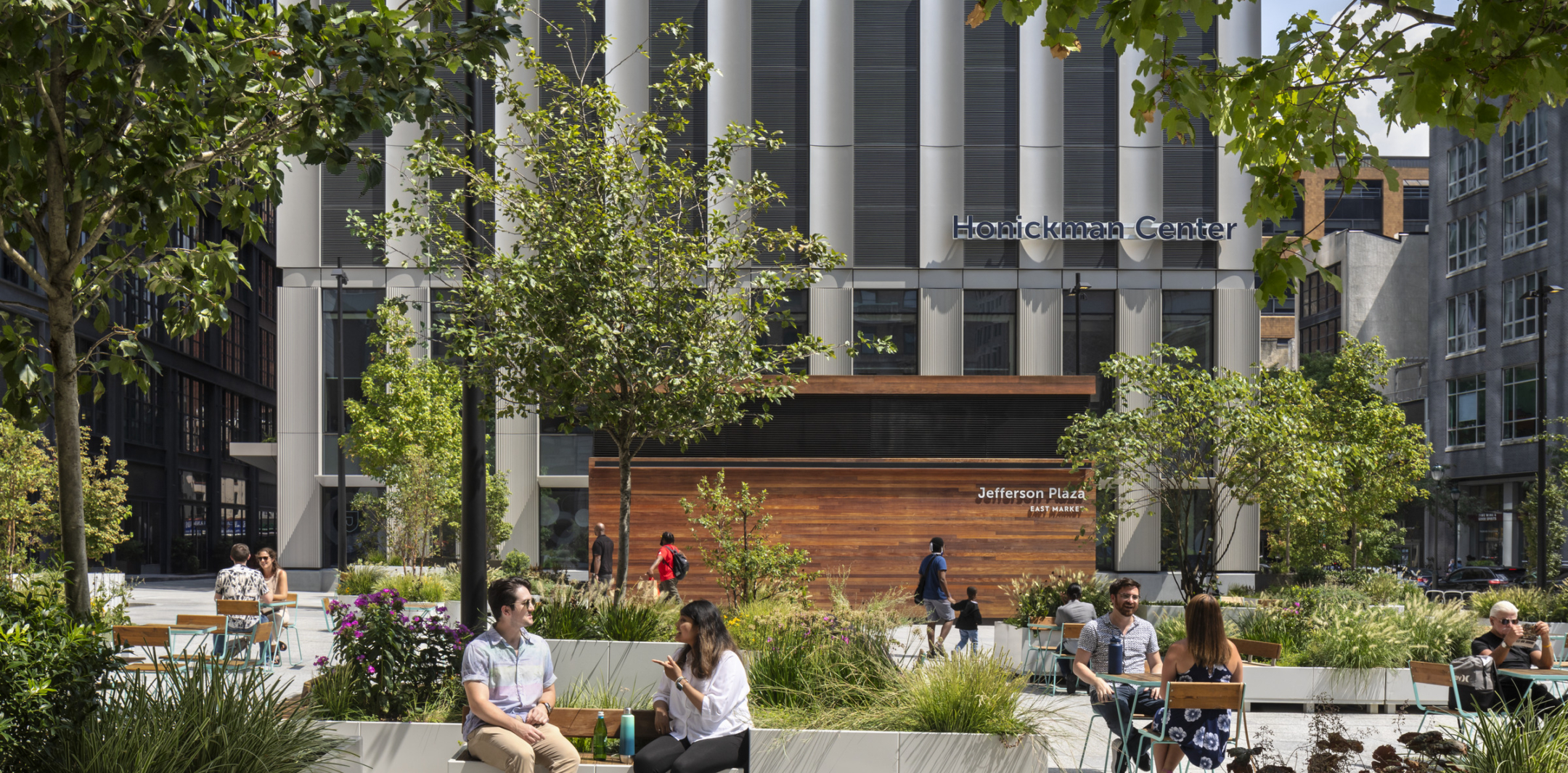
Since Jefferson Plaza opened in Philadelphia in 2023, pedestrians have flocked to this outdoor living room in the city’s revitalized East Market neighborhood. Photograph by Andrew Rugge © Perkins Eastman

Spurred by the need to boost pedestrian safety, enliven urban cores, and create “social infrastructure that supports belonging, well-being, and public life,” cities are undertaking projects large and small to make their downtowns more appealing, according to Urban Land. Such public realm efforts in older, more established environments require creative approaches while also accommodating critical infrastructure. The challenge for designers, clients, and local stakeholders is to transform complex, disparate priorities into contextually responsive solutions that give placemaking destinations their form and character.

Design Integration

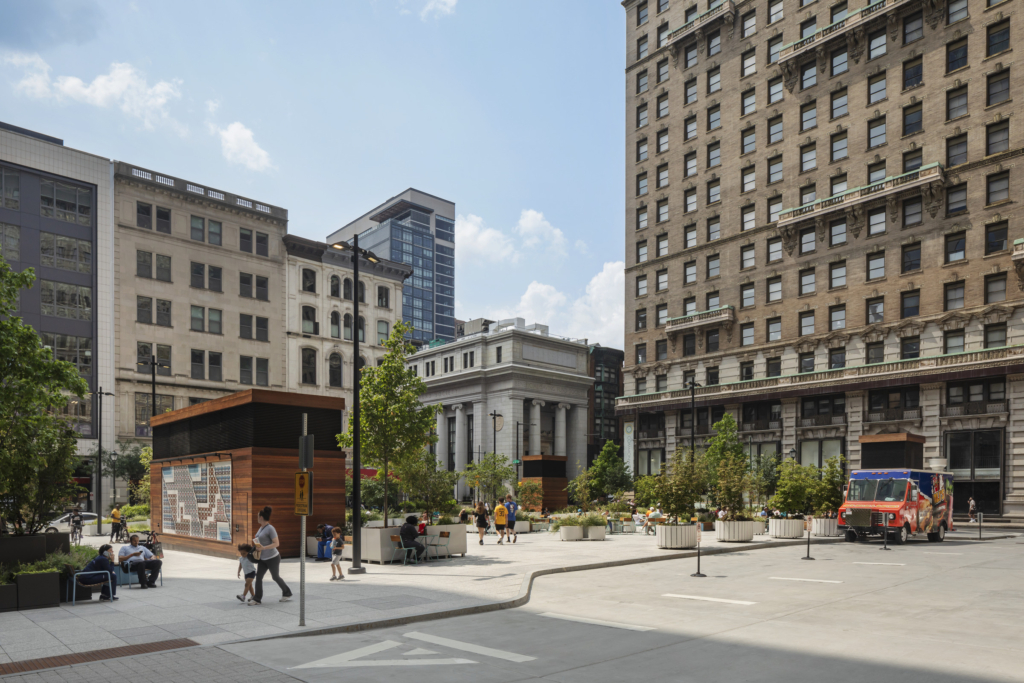
One such project, Jefferson Plaza, offers 20,000 square feet of vibrant, landscaped public space in Philadelphia’s East Market neighborhood. The plaza’s seating, tables, public art, and pavers replaced a parking garage structure—a barrier to street life—but that doesn’t mean the car park is gone. Our design team moved it underground, freeing street-level space for active, human-centered use.
Outdoor Art Installation, or Is That the Way to the Parking Garage?

Jefferson Plaza provides a new civic gathering space serviced by food trucks along Chestnut Walk and framed by wood-clad headhouses that integrate public art. Photograph by Andrew Rugge © Perkins Eastman

We emphasized integration, turning infrastructure into celebrated features. Three wood-clad headhouses define the plaza’s perimeter, offering warmth and texture while discreetly housing parking garage egress stairs and ventilation shafts. The largest headhouse incorporates a public art wall that anchors the southern end of Chestnut Walk, the pedestrian corridor established by our East Market master plan that activates a full city block with connections between Market and Chestnut streets. This densification of uses within simple, contemporary forms reflects our approach: combining a deep understanding of urban systems and contemporary technology to accommodate essential services in a welcoming new civic space.

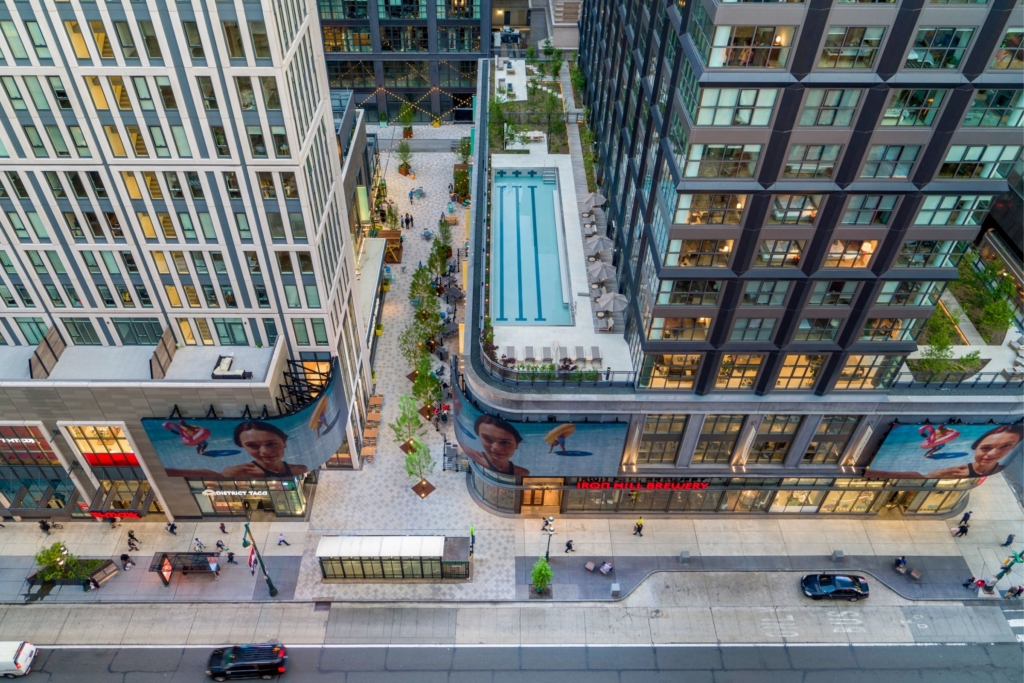
Jefferson Plaza marks the public heart of the East Market master plan, which the Philadelphia Inquirer lauded as “a model for how to do large-scale, mixed-use redevelopment in a city with a colonial-era street grid and a wealth of historic buildings.” Here, residents and visitors enjoy a revitalized district near Philadelphia City Hall. Faced with a block that had fallen into disuse, with outdated retail, vacant offices, and cross streets that were little more than service roads for trash, loading docks, and parking, we carefully allocated public space and set out a long-term strategy for how it would grow and be supported over time. At the core of our plan and inspired by the city’s historic mid-block streets that were originally created for horse-drawn carriages, Chestnut Walk is scaled for pedestrian life.

Much of East Market’s success is invisible, as rigorous planning below ground stitched together a complex network of disparate basements into parking and a new service system in which loading docks, dumpsters, and utility rooms serve the buildings that sit on the block’s six parcels.
Outdoor Art Installation, or Is That the Way to the Parking Garage? 3

Residential towers, a hotel, updated offices, and a medical-office building have risen on this Philadelphia block over the last 12 years, guided by the East Market master plan. Two mid-block streets, street-level retail and dining,
and the new Jefferson Plaza at the southwest corner create a pedestrian-friendly public realm.
Photograph © Ray Cavicchio


Hiding in Plain Sight
Outdoor Art Installation, or Is That the Way to the Parking Garage? 5

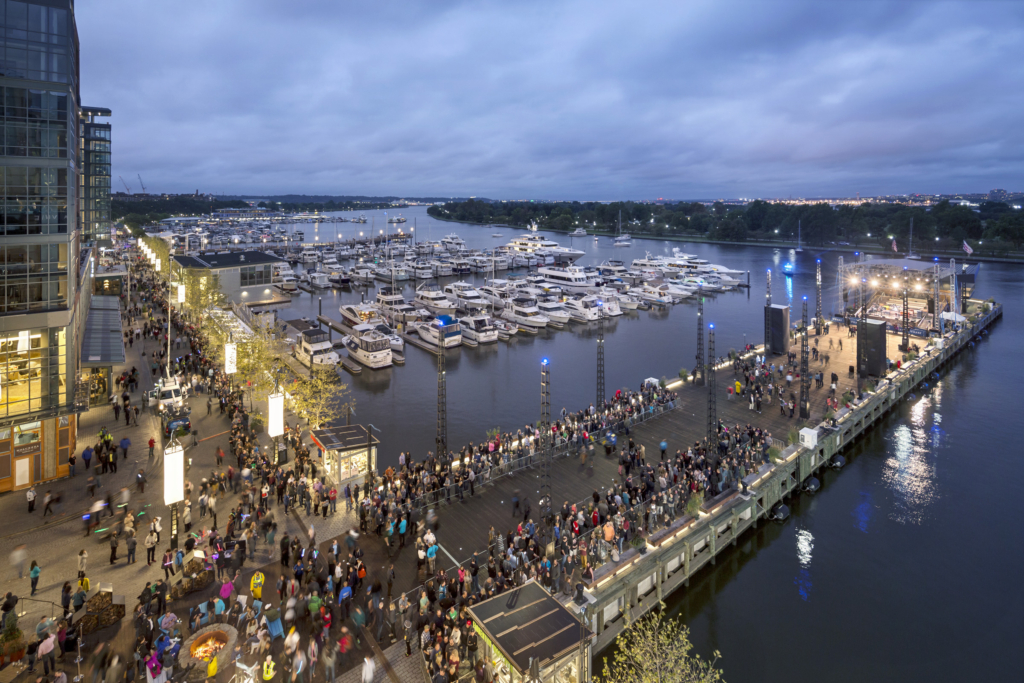
In Washington, DC, The Wharf’s esplanade has a pedestrian-scaled cadence punctuated with illuminated pillars that contain electrical wiring and public-speaker systems. Photograph by Andrew Rugge © Perkins Eastman

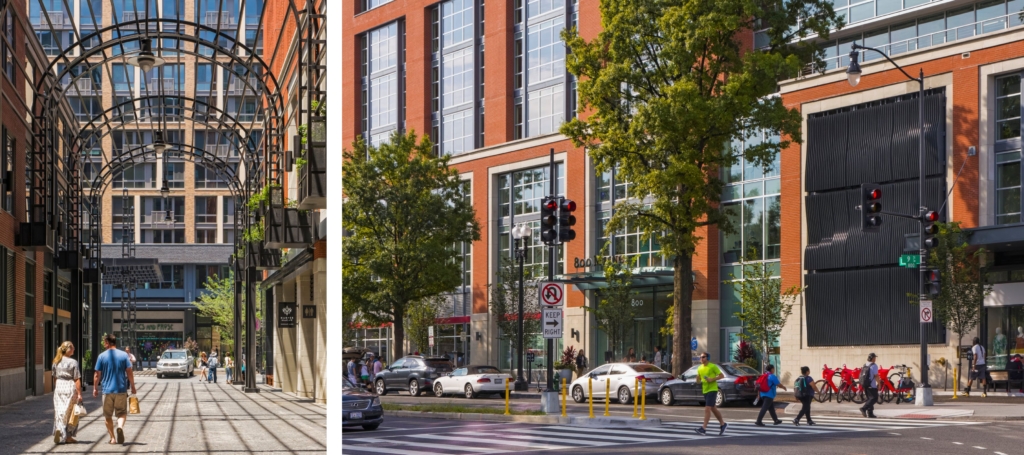
Many disguises are at play at The Wharf in Washington, DC. Our transformation of the long-underutilized waterfront into a bustling destination for residential, commercial, retail, and entertainment required an enticing public realm to knit together the mile-long district, which also had to include extensive infrastructure. Alleyways known as mews offer space for loading areas, building service entries, and public restrooms, but they are also designed as quiet escapes and walking routes. Illuminated pillars cleverly hide miles of wiring and speaker systems while animating the pedestrian experience. A concert hall’s loading docks recede into a colorful mural featuring giant penguins. Decorative metalwork covering a subway ventilation shaft satisfied the project’s public-art requirement.

Outdoor Art Installation, or Is That the Way to the Parking Garage? 6

The Wharf’s mews (left) provide space for loading, entries, and services, but they are framed with an arbor, balconies, and plants to prioritize the pedestrian experience. A large subway ventilation shaft is concealed behind decorative metalwork (right). Photographs © Jeff Goldberg/Esto.


Pedestrian-First Layering

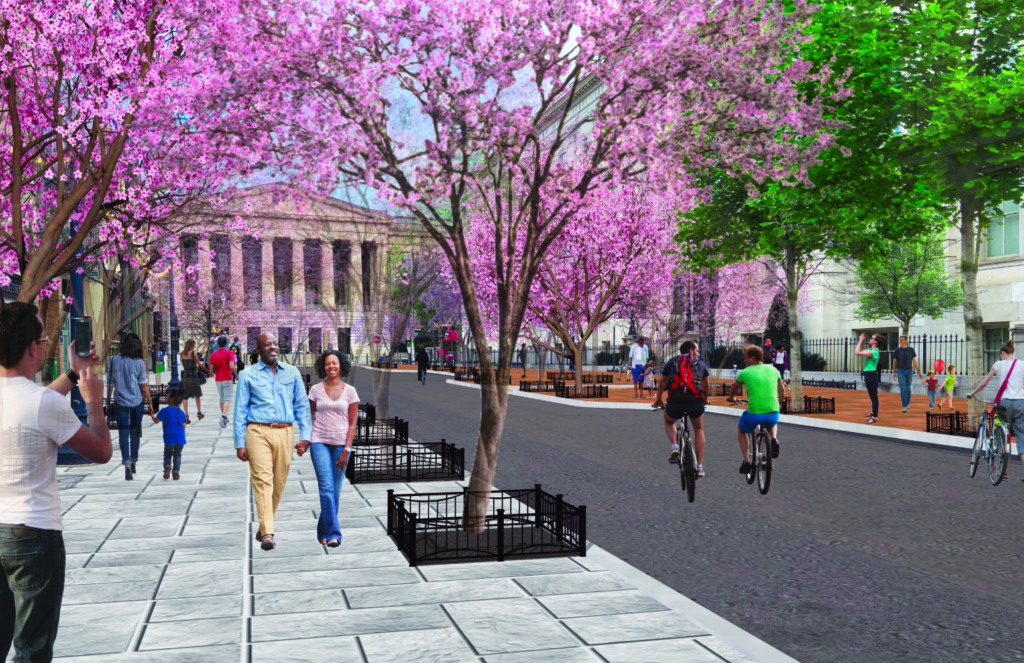
One subway stop north of The Wharf, the National Portrait Gallery and the historic Carnegie Library building bookend a section of 8th Street that is lined with service drives and loading zones. Working with the city’s Office of the Deputy Mayor for Planning and Economic Development, we have proposed a layering strategy to de-emphasize these elements with new street lighting, trees, rain gardens, and distinctive paving. Our plan would shift the hierarchy of the street to foreground a cohesive public realm while sustaining essential services.

Outdoor Art Installation, or Is That the Way to the Parking Garage? 7

Within the larger Downtown DC Public Realm Plan, our proposed corridor along 8th Street frames views of the National Portrait Gallery (above) to the south and the historic Carnegie Library building to the north.
Rendering © Perkins Eastman

A curb-free environment further repositions the street for pedestrians, allowing high-quality stone paving to extend across walkways and vehicular paths. Bollards, planters, and trees establish a pleasing environment while inhibiting the unchecked passage of cars, thus prioritizing people over vehicular traffic.

Reclaiming City Streets

As new technologies and modes of transportation continue to evolve, local governments are adopting long-term strategic policies to improve pedestrian safety. Several of them have tapped into the Vision Zero Network, a nonprofit collaborative that helps cities leverage federal grants to make their streets safer, and urban planners have responded with placemaking projects that expand no-traffic and low-traffic pedestrian zones. Perkins Eastman has adopted myriad approaches to this challenge, including integrating infrastructure within strategically designed encasements, masking it with pedestrian-focused features, and moving it underground to create street-level public space. Pedestrians are the beneficiaries, and cities become safer and more welcoming places in the process.