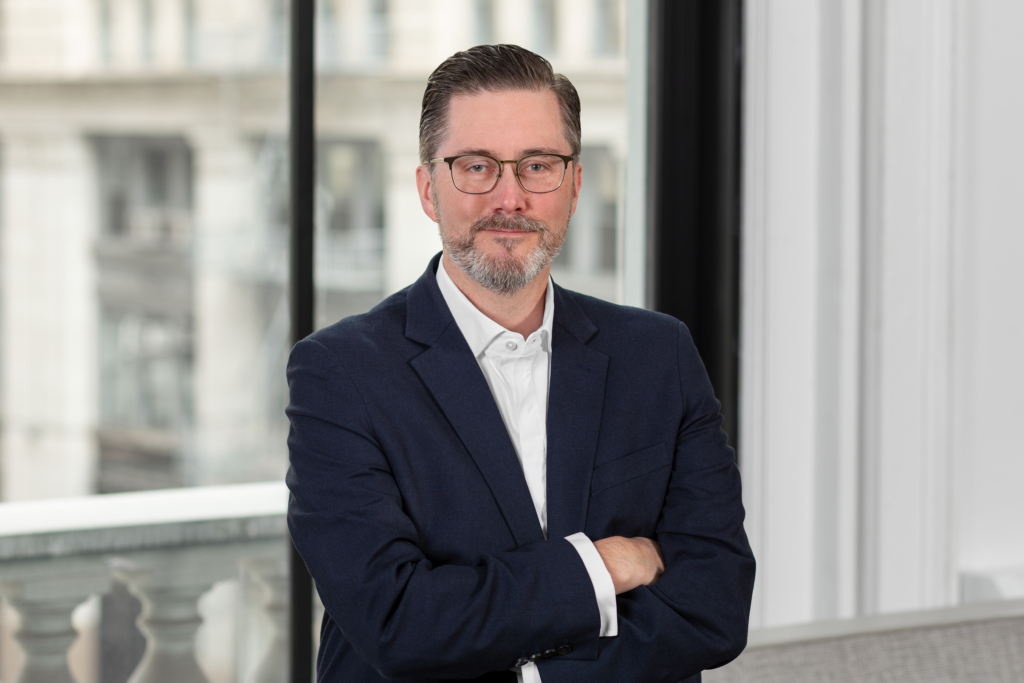
New York, NY (August 10, 2026) – Global design and architecture firm Perkins Eastman welcomes Matthew Malone, AIA, LEED AP, NCARB, as a principal and co-leader of its firmwide Science + Technology practice. Malone brings nearly three decades of experience shaping research environments, along with the unique perspective of working both as an architect and as a commercial developer.
That dual perspective allows Malone to guide projects from concept through construction while balancing design ambition against the realities of budget, schedule, and speed-to-market. Over his career he has partnered with developers, higher education institutions, pharmaceutical companies, and research and development organizations to deliver spaces that pair technical performance with architectural innovation. A graduate of Syracuse University’s School of Architecture, he has directed complex initiatives and contributed to award-winning work across the sector since 1997.
“We’ve been clear about our intent to grow this practice — not just nationally, but internationally — and to do it in a way which supports the industry,” said Nick Leahy, Co-CEO of Perkins Eastman. “Matthew brings the right expertise and understands what we believe: that these are fundamentally human spaces. It’s the reason a lab should be more than a machine for research. It can be a place that helps people do their best work and, ultimately, advance discovery which impacts the human experience.”
Malone’s arrival strengthens one of the firm’s rapidly-evolving practice areas. Science + Technology works in close partnership with Perkins Eastman’s College + University practice, which results in innovative computer science labs, wet labs, robotics facilities, and other incubator spaces. This work serves top-tier research institutions, global pharmaceutical and biotech companies, and science and technology development firms. Building on that foundation, Perkins Eastman sees significant opportunity to expand further into emerging typologies — including artificial intelligence, quantum computing, and pharmaceutical and biotechnology research centers — as innovation clusters reshape how and where discovery happens.
“What drew me to Perkins Eastman was that ambition, paired with a multidisciplinary platform that can actually deliver on it,” said Malone. “Research and development spaces don’t exist in isolation; the most exciting opportunities live at the intersections, where science meets the workplace, the classroom, and the communities these buildings serve. That’s exactly where a firm like this has an advantage.”
Malone also joins at a pivotal moment for the sector. After a period of ambitious lab construction, many owners and institutions are now confronting underutilized space. Malone’s developer experience positions him to help clients rethink, reposition, and reprogram these assets — designing for flexibility and long-term value rather than one-time occupancy.
For media inquiries, please reach out to: news@perkinseastman.com.