Nick Leahy: What stands out most in this year’s report?
Heather Jauregui: For the first time, we are reporting on the embodied carbon footprint of the work we are doing. We tracked a 15-percent reduction in relation to the Carbon Leadership Forum’s benchmarks for eliminating embodied carbon in buildings, materials, and infrastructure. While there is plenty of room for improvement, we’ve been able to quantify this so we can continue to make measurable progress.
Leahy: Now we need to help clients and stakeholders understand what embodied carbon is, why it is important, and how design and thinking about material choices will lead to better outcomes for people and the environment.
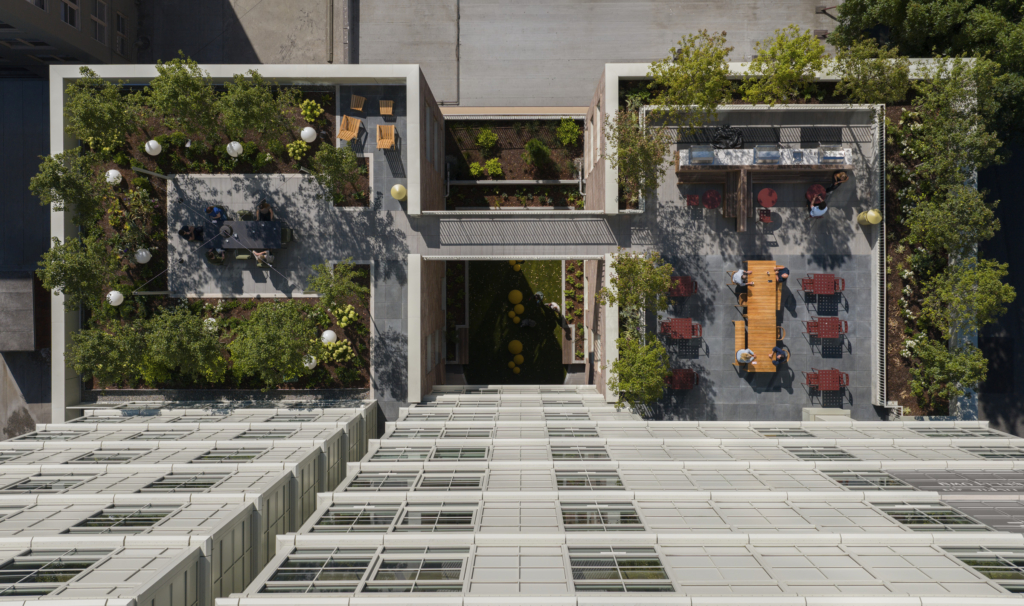
Kaye, a 31-story residential tower in Seattle’s Belltown neighborhood, earned LEED Silver Certification and a Fitwel two-star rating. Photograph © Seamus Payne
Jauregui: Somebody once told me that being a sustainability professional feels like a glitter bomb is constantly going off—and the glitter bomb is all the metrics and all the different ways we measure sustainability in our work. Focusing on metrics and measurements that mean very little to our clients instead of translating and tying those targets to what our clients value most—health, productivity, and quality of life— is sometimes to our detriment. Making sure that we are integrating our design approach through the lens of what our clients want is just as important as nailing down the targets.
From a big-picture perspective, how do you see sustainability as integral to our Human by Design ethos?
Leahy: People, planet, and the environment are symbiotic. Generally, people underestimate the value of the built environment and its impact on all aspects of our well-being. For us to thrive, the planet must thrive. Once we understand design in that way, it’s clear that sustainability is fundamental to it.